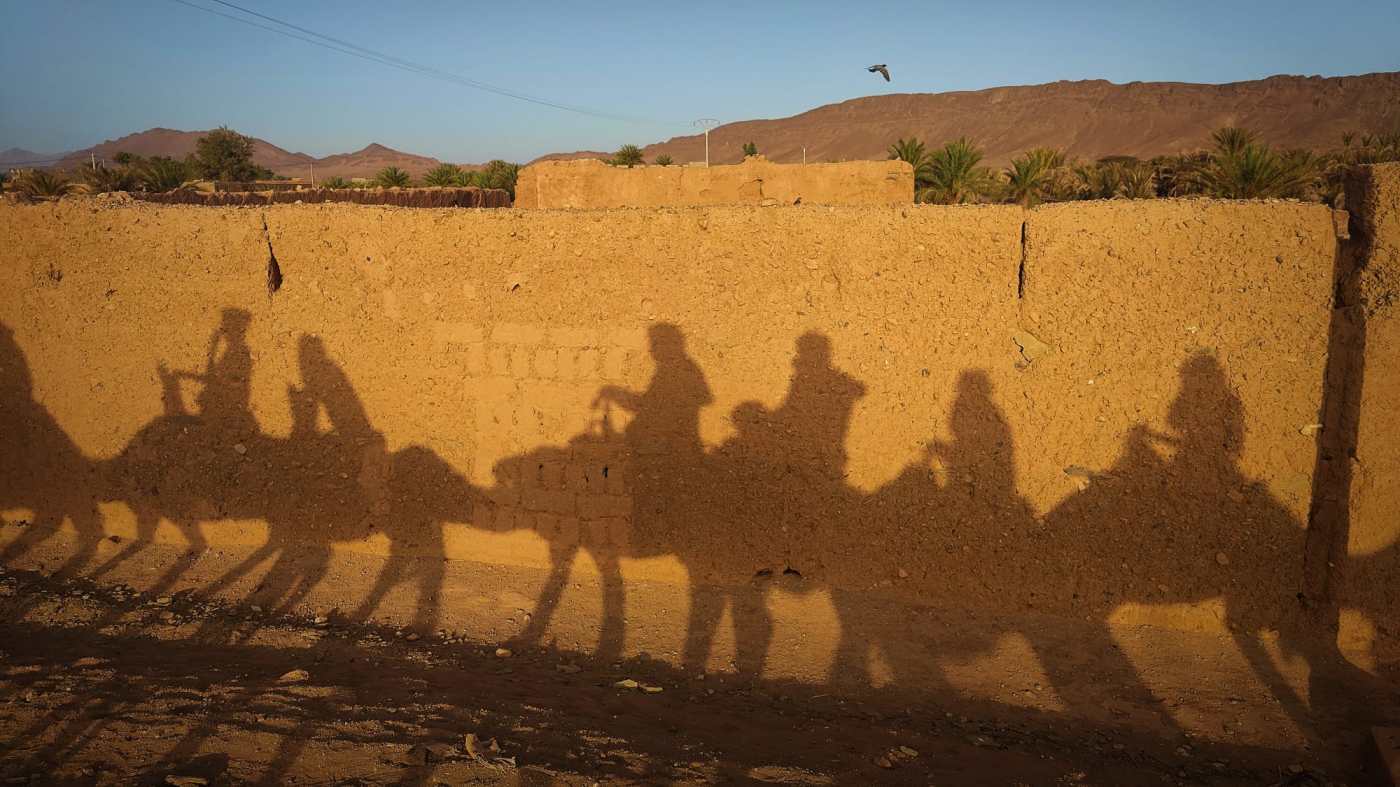
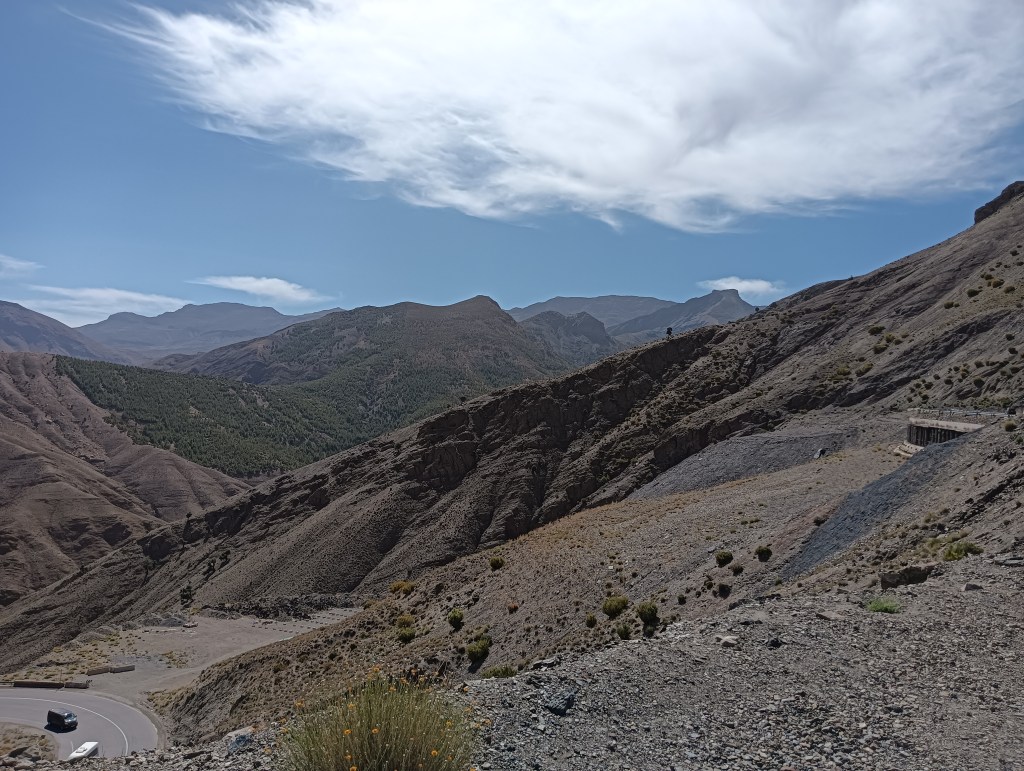
From the mayhem of Marrakech, we ventured to a very different part of Morocco in our quest for the extraordinary. We embarked upon a road trip to Zagora, a small area within the Sahara Desert. Our trip by road was somewhat lengthy but gave us a great opportunity to travel through the High Atlas Mountains, through the Tizi n Tichka pass which is around 2,260 metres above sea level at some points. This pass links the south east of Marrakesh to the city of Ouarzazate where we stopped briefly to grab lunch.
The Atlas Mountains are in the centre and south of Morocco, running down the backbone of the country with the highest peak being Toubkal at 4,167 metres above sea level. The Rif mountains are in the north of Morocco and these mountainous areas are inhabited only by the Berber people.
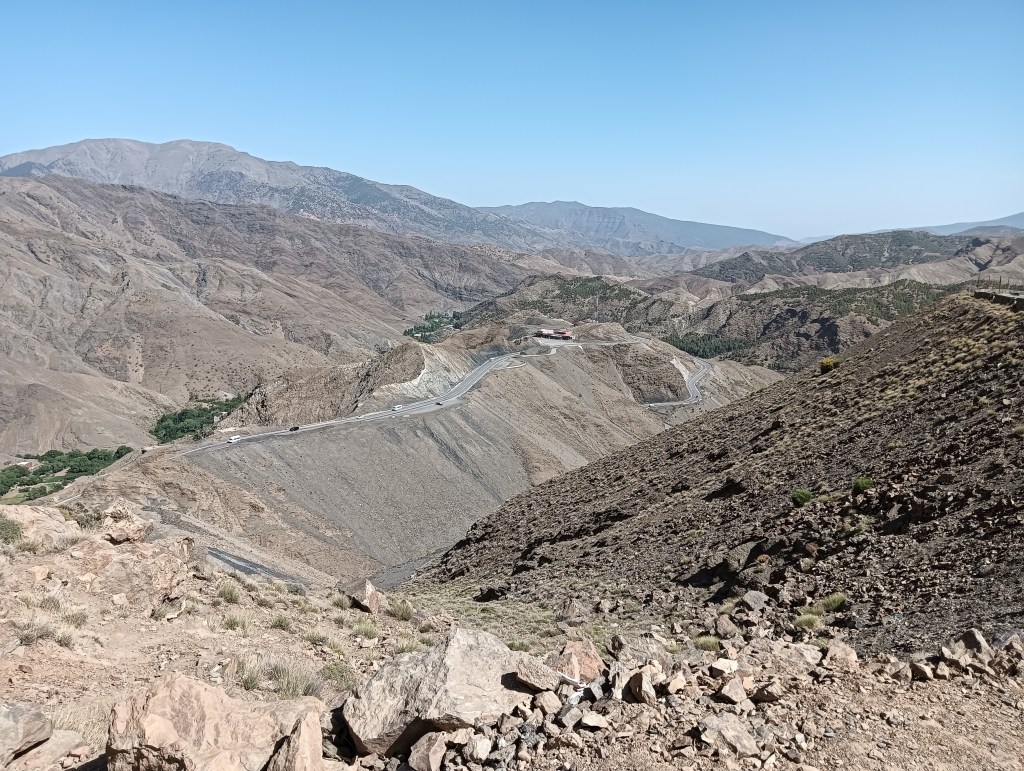
As the vehicle wound its way over the mountains along treacherous cliff-edge roads, we were afforded spectacular views of numerous valleys, with some greenery on the way which was surprising given the barren and scorched earth all around us. There was evidence of where rivers and streams would sometimes flow but when Mr Nomad and I visited, there was no water apparent at all. We also were able to see the hill side villages occupied by the Berber people.
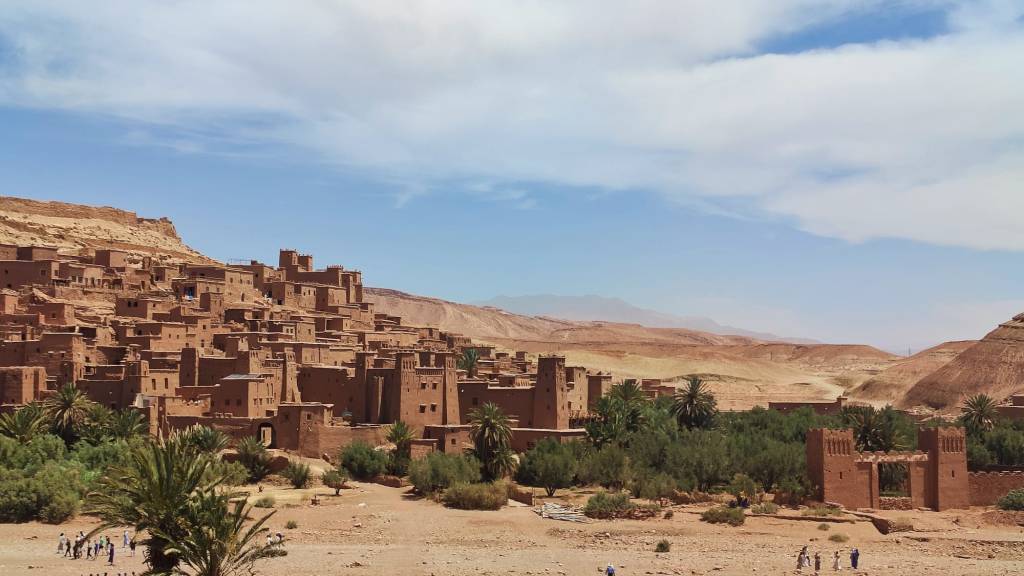
Enroute to our ultimate destination, we stopped to visit a the imposing Ksar of Ait Benhaddou. A Ksar is made up of kasbahs and is a fortress. Much of Ait Benhaddou has been fortified since before the 11th century. This particular fortress is one of the most important fortresses on the ancient salt caravan route where traders in days gone by brought slaves, gold, ivory and salt from sub-Saharan regions, from Africa to Marrakech and beyond. It is a great example of Moroccan earthen clay architecture and has been a UNESCO world heritage site since 1987. It is made entirely from earth, adobe, clay, bricks and wood and was an incredible sight to behold.
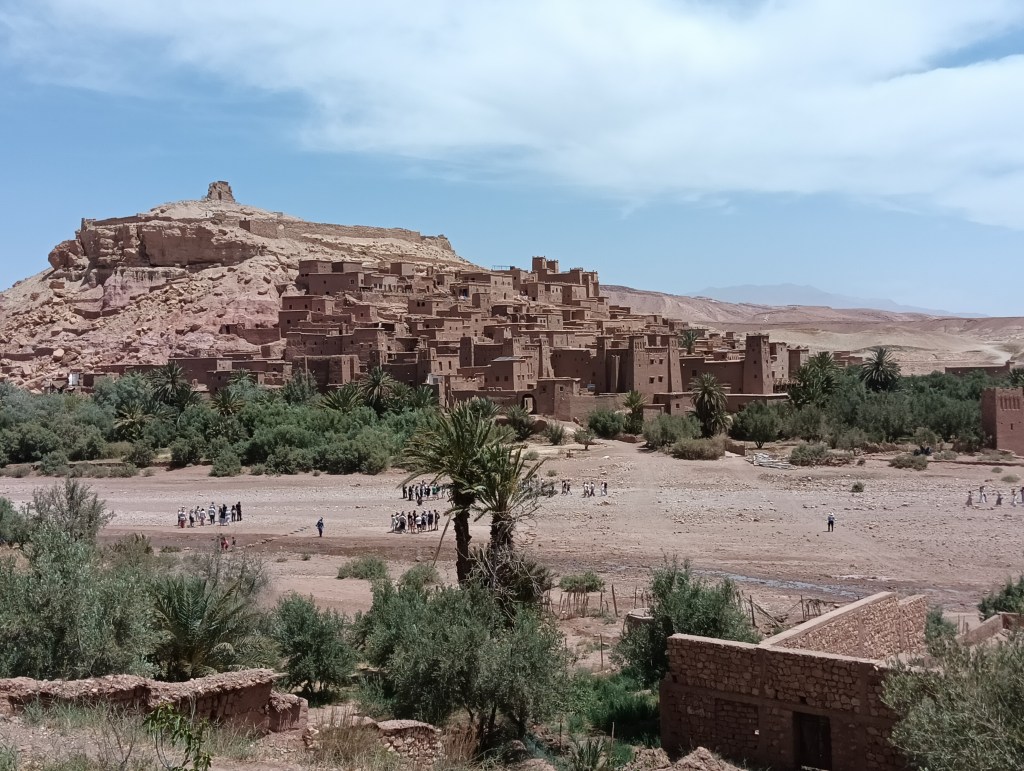
The Ksar was now home to only handful of families but used to be a thriving community. It stood on the banks of the river Ounila and a foot bridge was built over this river in recent years but the river itself has long since dried up. The residents of those numerous kasbahs have slowly but surely evaporated like the river as trade has become more infrequent and people have simply moved away in search of a more prosperous way of life.
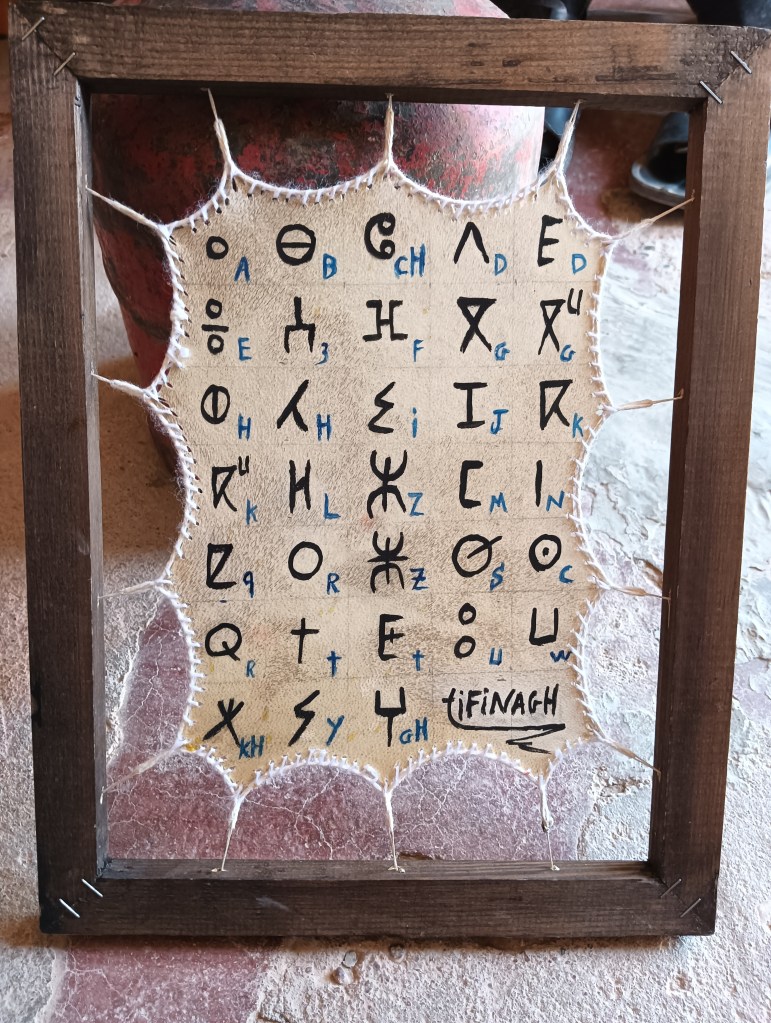
A noticeable detail in this region was the intense heat. It was very hot and dry, and the sun was overbearing. It was a taste of the dry heat to come in the desert but it was easy to see that in modern times, this inhospitable landscape was challenging to occupy. That said, the trek across the dried up riverbeds, into the Ksar itself, up through the rocky and winding pathways was fascinating. It was almost medieval and still in its original form since it was built, aside from some damage from an earthquake in 2023. Mr Nomad and I came across some wonderful artistry by the locals with displays of paintings created from saffron, tea and henna and brought to life with a flame. We were transfixed as a Berber gentleman signed our names on a hand made picture in the traditional Berber language.
The magnificent ksar of Ait Benhaddou has become more well known in recent years being the site of many Hollywood movies such as Lawrence of Arabia (1965), The Jewel of the Nile (1985), The Mummy (1999), Gladiator (2000) amongst many other famous hits. Some scenes from numerous seasons of the great series, Game of Thrones were also filmed there which was more than thrilling for Mr Nomad and I who had been die hard fans of the show. There were scenes filmed in the neighbouring city of Essaouira which our vehicle passed through and we were able to glimpse the film set for the up and coming Gladiator 2 film which has yet to be released.
Our vehicle proceeded through another passage – Tizi n Tinififi – before reaching the Draa valley in Agdez and all the while, we melted in a cramped minivan with little to no air conditioning. The lack of air circulation however acclimatised us for the unbelievable and extreme heat of the Sahara desert.
The Sahara desert spans North Africa and with an area of around 9,200,000 square kilometres is the largest hot desert in the world. It covers Algeria, Chad, Egypt, Libya, Mali, Mauritania, Niger, Western Sahara, Sudan, southern Morocco and Tunisia. It is so large and bright that in theory, it can be detected from other stars as a surface feature of Earth. It is considered to be hyper-arid so there is sparse vegetation. The permanent absence of clouds allows unhindered light and thermal radiation and rainfall is virtually non-existent. In other places that we have visited, Mr Nomad and I have had cause to refer to ourselves as the ‘rain bringers’ so it was strange to journey to a place where there would be no rain fall at all; ever. The only perspiration was my own.
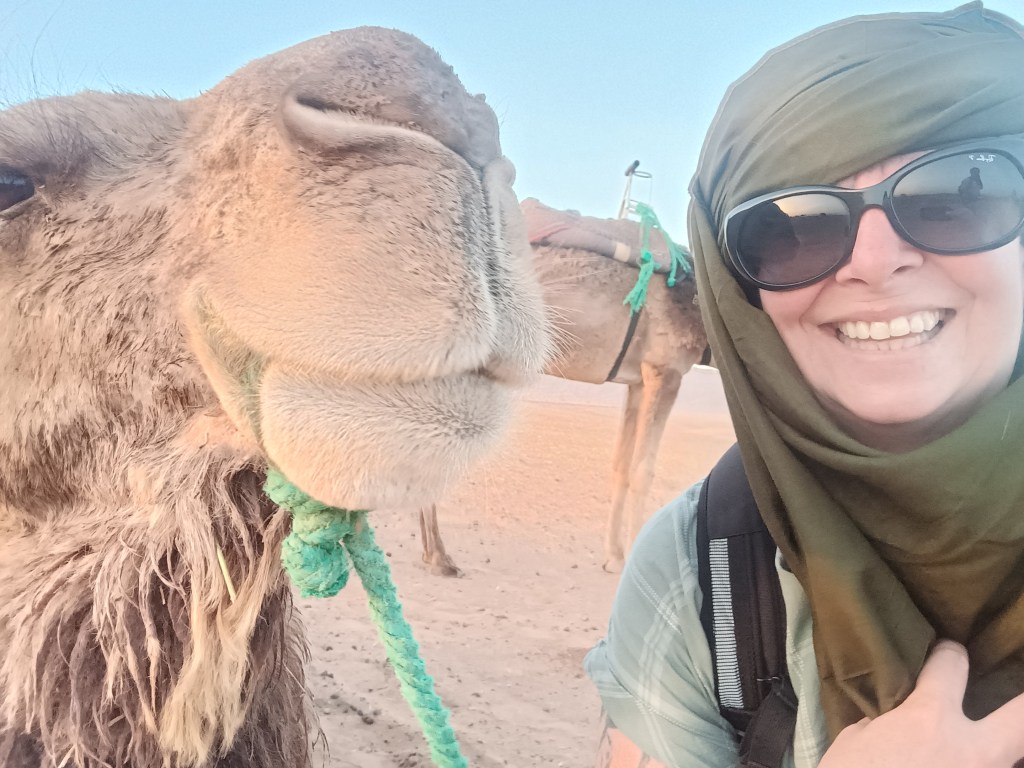
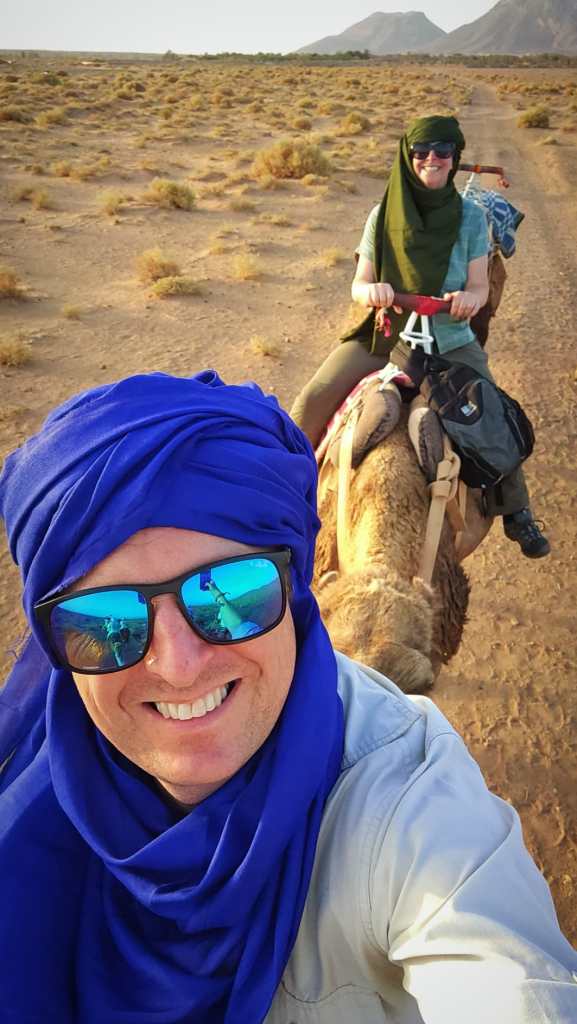
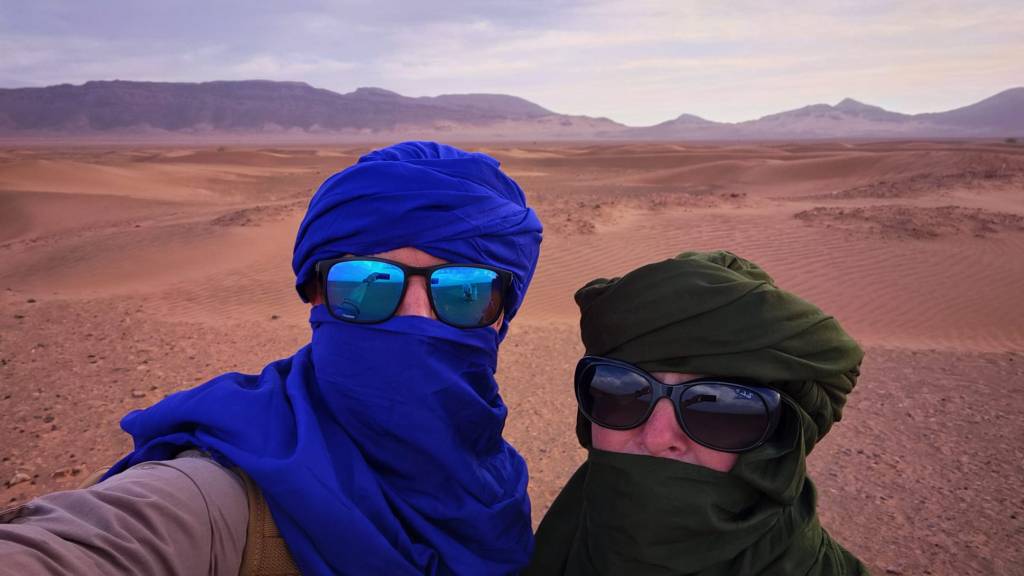
We rode into the Great desert on a camel which was wonderful. My camel was called Alihassan but Mr Nomad preferred to call him Geoffrey. I have ridden thousands of horses and ponies in my life time, but never a camel and although a very different and slightly weird experience, it was a fantastic and traditional way to enter this alien landscape. It was barren, and seemingly devoid of flora and fauna and like another world. The Sahara is distinctly rocky, with frequent gusts of wind creating giant sand dunes. The camels made short work of this, their huge splayed 3 toed feet perfect for striding across an ever shifting surface. We sauntered along, our heads wrapped in a traditional headdress adorned by the Berber people and no doubt the infamous Bedouin folk and was literally a life saver whilst the sun beat down upon us and the wind whipped up the sand, stinging the eyes and chapping the lips. Although there is little wild life, the sand seemed to take on a life of its own, swirling in the wind, building up into the dunes which this backdrop is famous for.
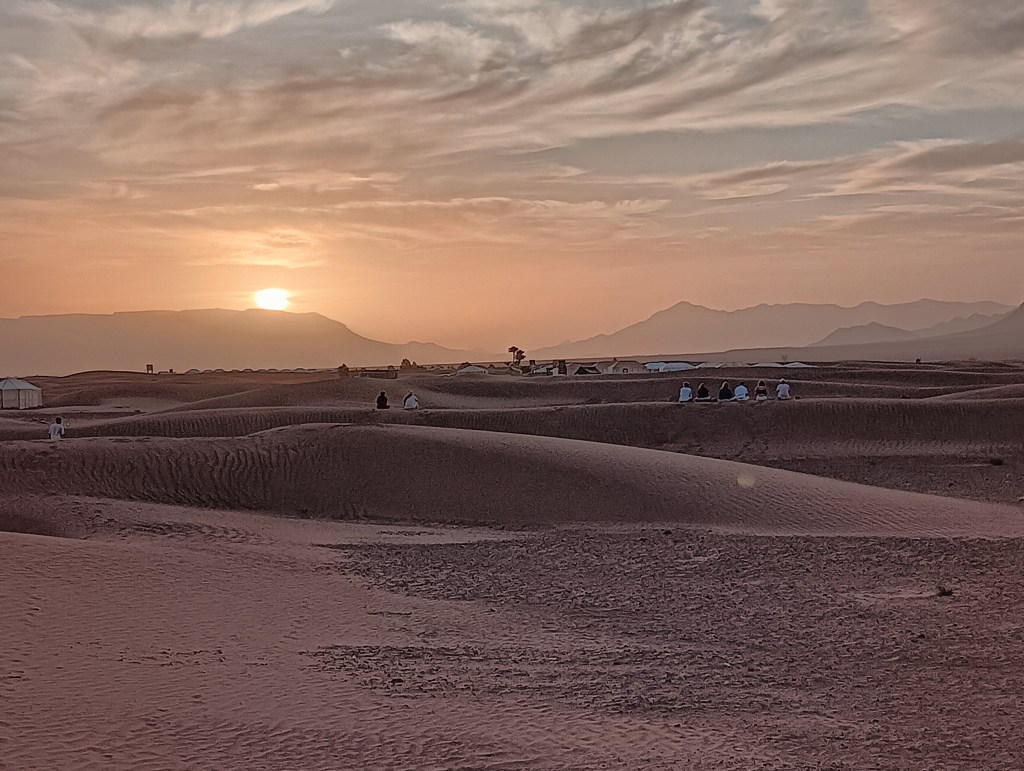
The lack of light pollution made for the most fantastic sunset. Mr Nomad and I dismounted our desert steeds and settled upon a dune to witness a spectacular and undisturbed sunset. There was nothing going on around us at all and in direct contrast to Marrakech, there was complete silence, and an almost eerie peace. We were in a very remote spot on the planet, unpopulated and uncomplicated and it was unadulterated bliss.
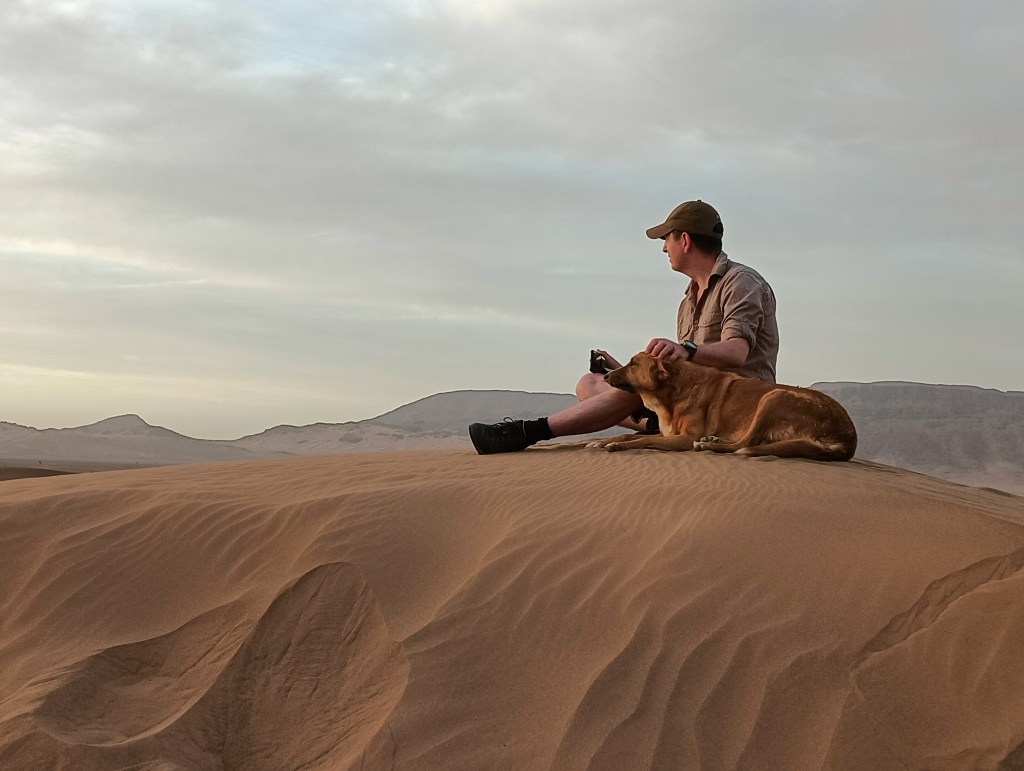
True to every other adventure we have ever embarked upon, Mr Nomad attracted the attention of a dog. Of all places, where very little thrives, there was still a dog! She was a beauty though, and even with her snaggle tooth, we had to remind ourselves not to take home any more dogs. She belonged to the Guide who had accompanied us on the camel ride, who looked after those camels and who hosted us, providing us with an awesome welcome. He was a Berber chap and he provided us with a very welcome glass of atai (mint green tea). Despite the bleak conditions around us, he served us the most amazing feast of soup with handmade bread, chicken tagine and cous cous. Who knew such hospitality could be found in such an inhospitable place!

The heat however was relentless. The high position of the sun, the extremely low relative humidity and the lack of vegetation and rainfall make this desert the hottest large region in the world and the hottest place on Earth in the summer months. Only Death Valley in California rivals this! The sand and ground temperature are even more extreme and to say that Mr Nomad and I felt this would be an understatement. Even at night, the temperature was unbearable and in our bivouac in the nomadic tents, this did not make for a restful night’s sleep. The lack of washing facilities meant that the following day, Mr Nomad and I smelled somewhat ripe. But this was an adventure like no other and the burning landscape which we found ourselves in was mystifying. Being able to witness a stunning sunset, with the silky silhouettes of the camels in the distance followed by the burst of thousands of twinkling stars in the darkest night sky was incredible and rather romantic, . The morning sunrise was equally as spectacular and this sojourn had been more than worthwhile, despite the arduous road trip to get there.
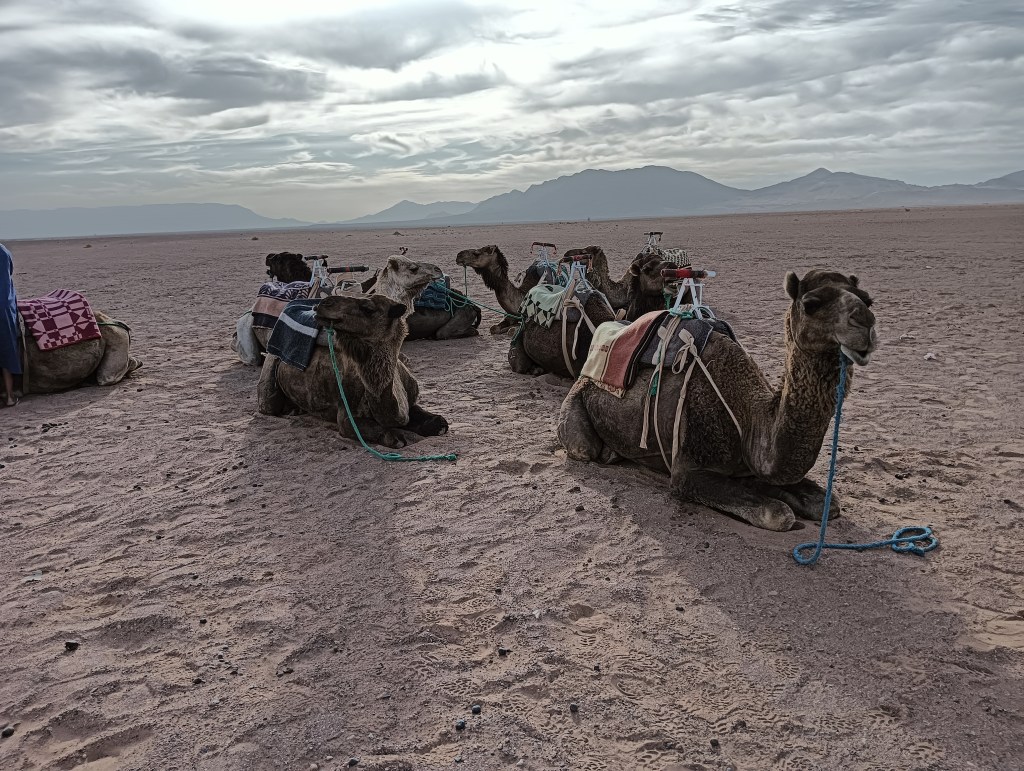
We were greeted by the low rumbling of the camels once we had risen and we jumped aboard, reluctantly ambling back to civilisation.
The road back took us through the Atlas mountains once more and we stopped off to visit another Ksar which although interesting, was not quite as impressive as Ait Benhaddou. We also took some time to visit a community-ran rug shop which was fascinating. The Guide here explained that the rug shop was a place where they accommodated members of the community who had no other employment, and were seemingly homeless so it was interesting to see where people who would otherwise be down on their luck were taken in.
Upon our return to Marrakech, we ended our Morrocan adventure with a night out to Chez Ali. This was a show exhibiting traditional Moroccan culture and is described as ‘magical, grandiose, authentic, the Chez Ali dinner show’ with the ‘warmth of the Orient’ to the thematic Thousand and One Nights. It was an entertaining night with Moroccan cuisine and that food was accompanied by folk troupes who paraded through the dinner tents playing folk music and representing the regions of Morocco. The food was divine – we were served the traditional Harira soup followed by tagine and a 7 vegetable cous cous.
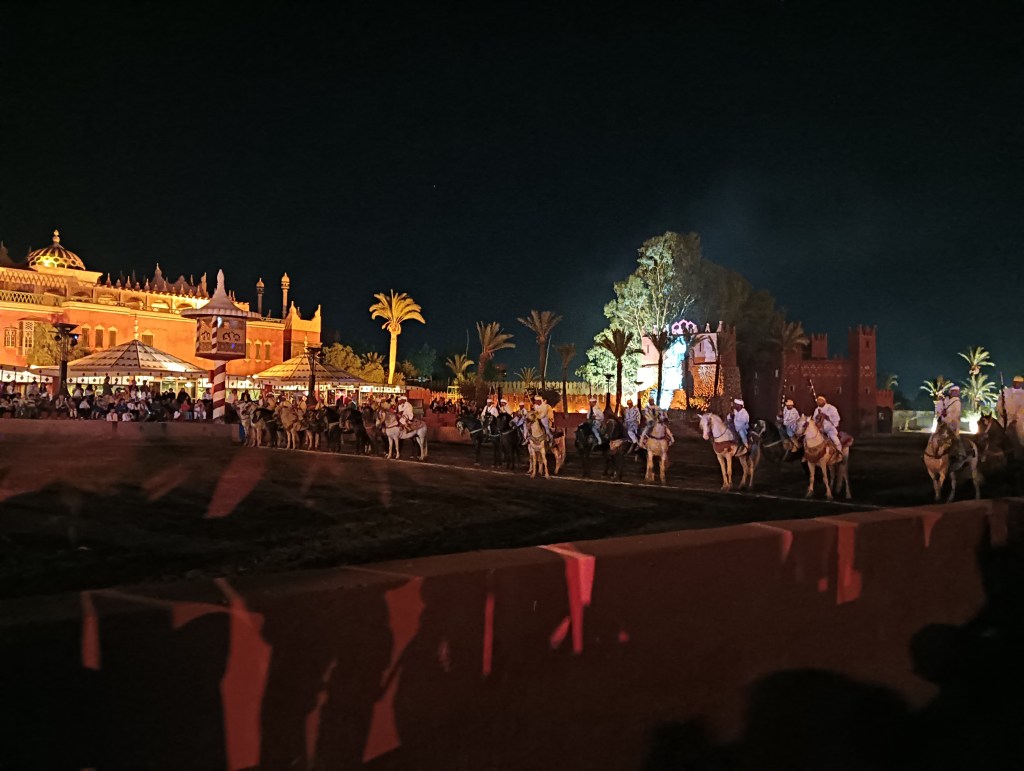
Following the meal, we were ushered out into a large arena where chaos reigned supreme with galloping horses thundering around the arena, coming to an abrupt halt with their riders gleefully shooting their rifles into the night sky, much to our shock! The riding skills on display were breathtaking, the horses seemingly fearless in the furor of gun fire. There was much noise with loud gunshots and the excited whooping and squealing from the horsemen. The outfits were garish and colourful, and the show in general was a real spectacle which in my mind, epitomized Marrakech and was exactly what I had come to expect from this crazy city.
There were camel rides, a belly dancer seductively hynotising the crowds with her rhythmic swaying, farm yard animals being paraded around as well as a magic carpet that flew in! It was a dazzling display of the magic of Morocco and a very fitting end to this most marvellous and unforgettable adventure.
The madness of Marrakech, the strange serenity of the Sahara and the charming Chez Ali had taken my breath away but in very different ways and it had in no way disappointed.
#epicadventures
#livelife
 Nomadic Family Unit
Leave a comment