Mr Nomad and I yearn for adventure to escape the daily grind so our latest trip saw a return to the African continent, but to North Africa. We embarked upon a journey to the Kingdom of Morocco, to stay in part in the city of Marrakech but to also visit the depths of a desert, the Sahara to be exact.
Morocco overlooks the Mediterranean Sea to the north and the Atlantic ocean to the west and has land borders with Algeria to the east and the disputed territory of Western Sahara to the south. It is incredibly well placed to have links to Europe, being so close to Spain and France and is also of course, African but with links to the middle east. There is a population of around 37 million and the predominant religion is Islam. Some 99% of the population follow Islam, and the official languages of the country are Arabic and Berber. French and a Moroccan dialect of Arabic are also widely spoken.
The capital city of Morocco is Rabat, although the largest city is the port city of Casablanca. Mr Nomad and I were drawn to Marrakech, a city popular with tourists and lying at the foothills of the Atlas mountains. The country is largely mountainous with rugged terrain owing to the Atlas mountain range which essentially runs down the backbone of the country, from the centre to the south with the Rif mountains in the north. Toubkal is the highest peak standing at 4,167 metres above sea level which in days gone by, Mr Nomad has climbed. Whilst we were going to cross the mountains when we ventured into the desert, the purpose of the trip was not to scale the heights but to discover a different culture, to enlighten ourselves but to also seek some respite from our daily lives.
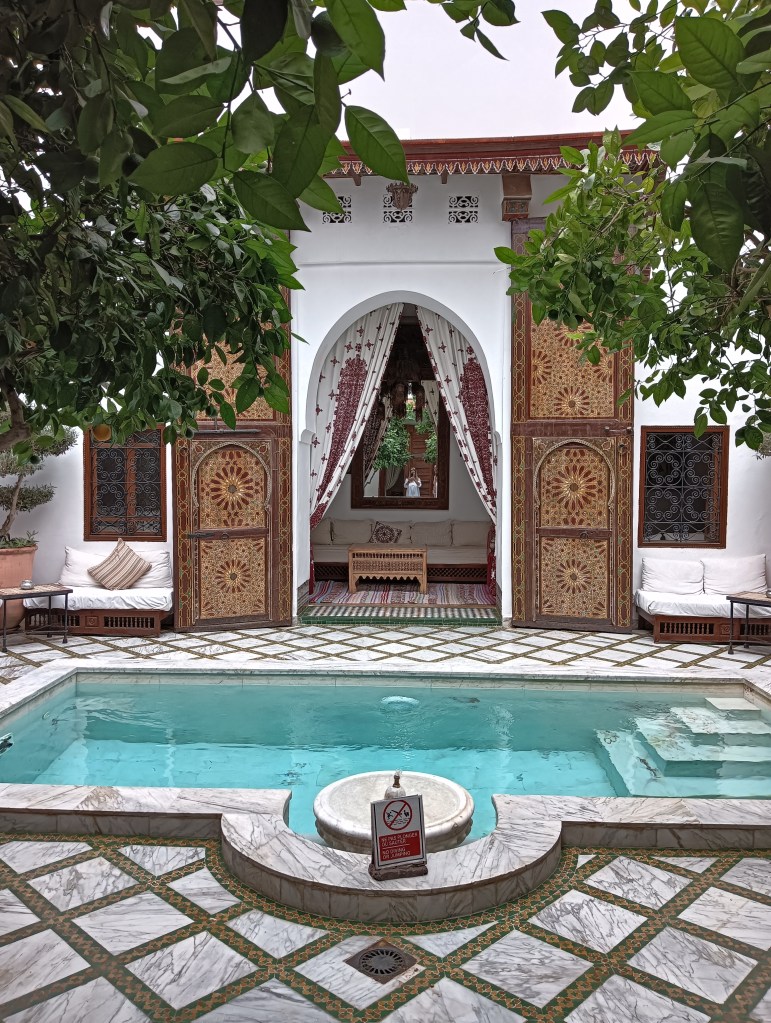
We landed without issue and the taxi ride to our accommodation gave a flavour of what was to come. The vehicle raced through narrowing streets, eventually coming to a halt in a tiny square with the driver ushering us out to walk the rest of the way with our luggage through the tiniest network of winding alleys.

Our accommodation was breathtaking – a small and serene Riad which was intimate and quiet. Mr Nomad and I felt in heaven and decided to rest and recuperate after our travelling before exploring the city the following day. The Riad is family owned and there were several separate buildings for guests to stay in and the rooms were surrounding a small square or courtyard. We were lucky enough to have a small swimming pool in our square, right outside our bedroom. It was all rather tranquil, and in no way prepared us for the mayhem that would follow.

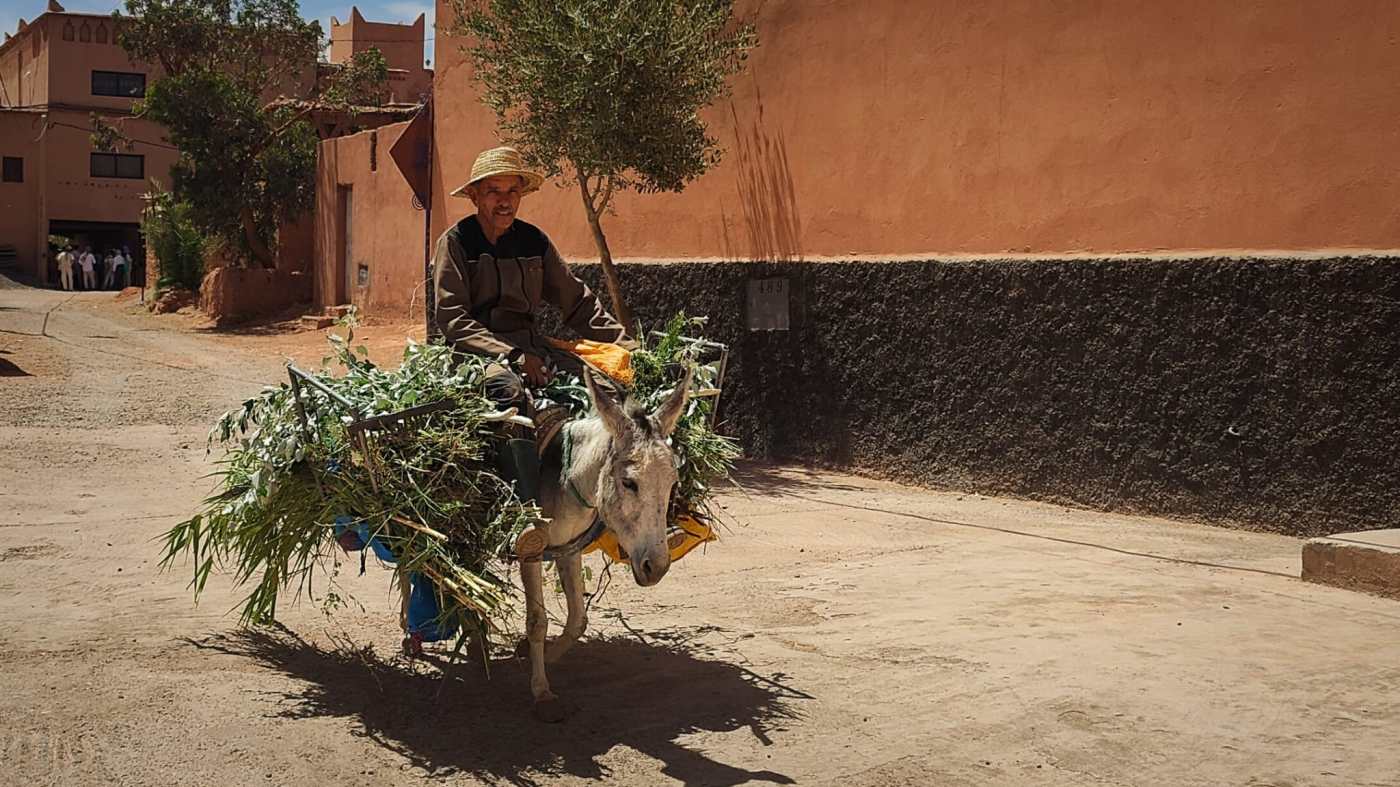
Marrakesh medina which houses the largest traditional market (souk) in Morocco has been designated a UNESCO world heritage site. However, we very quickly realised that Marrakesh is not for the faint hearted. Walking through the narrowest of streets was an assault on the senses; the smells, the sounds, the sights. There was no idle dawdling, but a frantic hustle and bustle with frenzied activity of people trying to weave their way through the maze of tight and tapering alley ways which were overfilled with down trodden donkeys pulling overburdened carts, hand carts being tugged along, ponies with bruised knees, battered from the daily grind; tuk tuks, motorbikes, expressive loud people selling their wares in the souks, luring unsuspecting tourists with promises of special sights that can only be seen on that day in attempts to extort money and tips at every opportunity.
The street food on every corner with its alluring smokey aroma was a contrast with the street food being prepared on open top butchery counters. Meat being butchered in plain sight – a delicate hooved leg being carved, fish being gutted with swift movements of nimble fingers. The stench of meat left out in the hot dusty arid environment, the putridity of the fish left out in the blazing heat was rather stomach churning but this was the Moroccan way.
Mr Nomad and I were lured into a visit to a local tannery with promises of special sights which ultimately led to a shop where attempts were made to palm us off with expensive rugs. We were plied with ‘atai’ – a green tea loaded with mint leaves and whilst I am not a tea drinker, it is considered impolite to decline so I sipped the tea until our hosts realized we were not going to make a purchase and we were chivvyed out of the souk to make way for more unsuspecting tourists.
The tannery was interesting but filled with pits of despair and acrid ammonia pools whilst the entertaining Guide accompanying us explained the process of hand stripping fur from skin by men as weathered as the hides they were preparing; a mint bouquet provided firmly wedged under my nose to disguise the putrid stench of a soulless profession.
The cacophony of hard work, of business, the pitter patter of hooves, the click click of flip flops, the roaring motorbikes up and down the tiniest of streets with cries of ‘keep to the right.’ There was no dawdling, or wiling away the hours and everybody seemed to be on a mission. This bombardment of chaos was overwhelming and a real shock to the system.
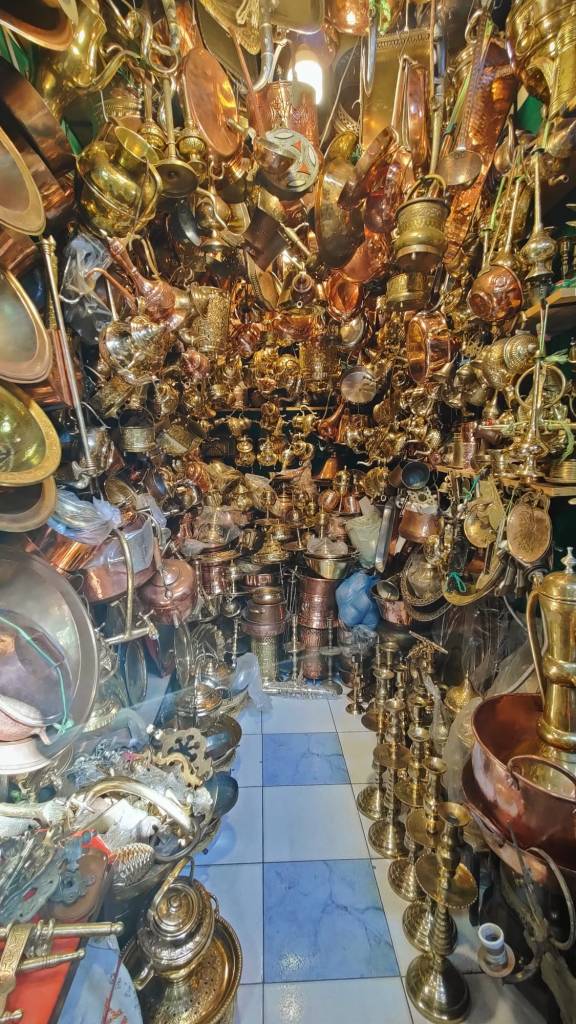
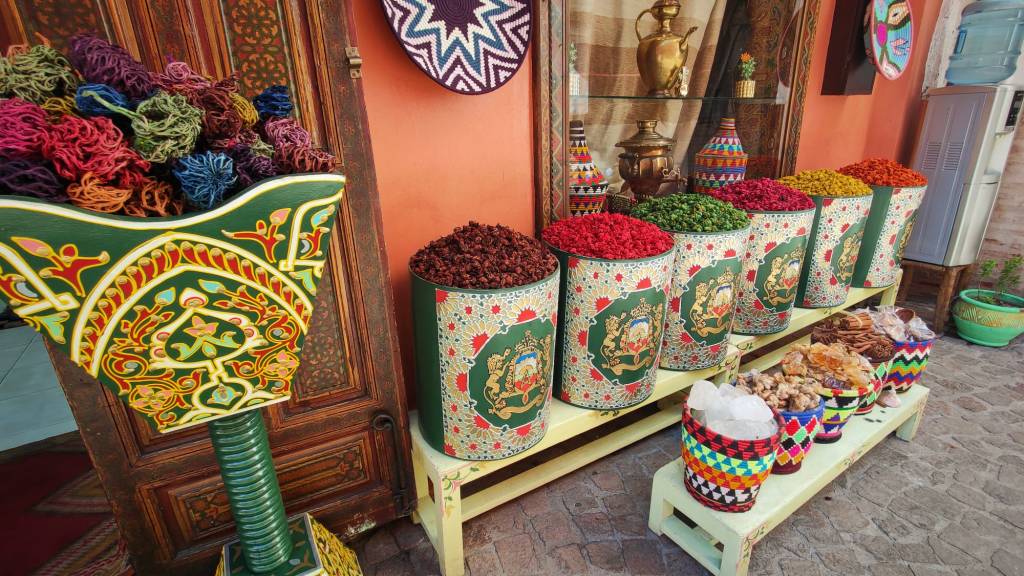
The souks are a fascinating experience with endless shops to barter within, emerging from intertwining streets, like a maze with endless rat runs, but with a vibrancy like no other. There were splashes of colour at every turn with an array of silks, cloth, fabric, woven goods, wooden items, leather products and coloured wool hanging out to dry. There was a heady deliciousness of fresh spices and aromatic soaps and oils which was a welcome change to the smells of raw meat and fish. There were fresh juices and smoothies from sumptuous fruits, glistening gold lamps and lanterns shining like beacons, showing the way down the cobbled and dimming corridors. It was brimming floor to ceiling with treasure and was an incredible sight.

The streets through the souks led to the busiest square on the continent – known as Jemaa el-Fnaa. Historically, the square had been used for public executions and in a modern era in 2011, was the site of a bomb attack which claimed the lives of 15 people, mostly tourists. The blast destroyed the Argana Cafe which was where out of coincidence only, Mr Nomad and I had stopped for a coffee break.
Escaping from its murky past, now there are many stands and stalls, people selling their wares but also it is a place that attracts many people from diverse backgrounds for entertainment, and where people congregate to socialise. It was dusty and dirty, busy and bustling with life and strangely exhilarating. There was the nasal chanting from the snake charmers with the king cobra’s appearing to be hypnotised, ladies decorating hands with henna, monkeys on chains as tourist attractions and photo opportunities, musicians, magicians, mystics and local people dressed in traditional and medieval attire. The local people would gather at the food stalls to consume a local delicacy of sheep’s head. I found this to be very off putting with the stare of glassy eyes, and gritted teeth from each decapitated head, awaiting consumption. However, despite my westernised distaste for the local cuisine, the medina was fascinating and the mayhem and chaos coming from every direction was oddly mesmerising.
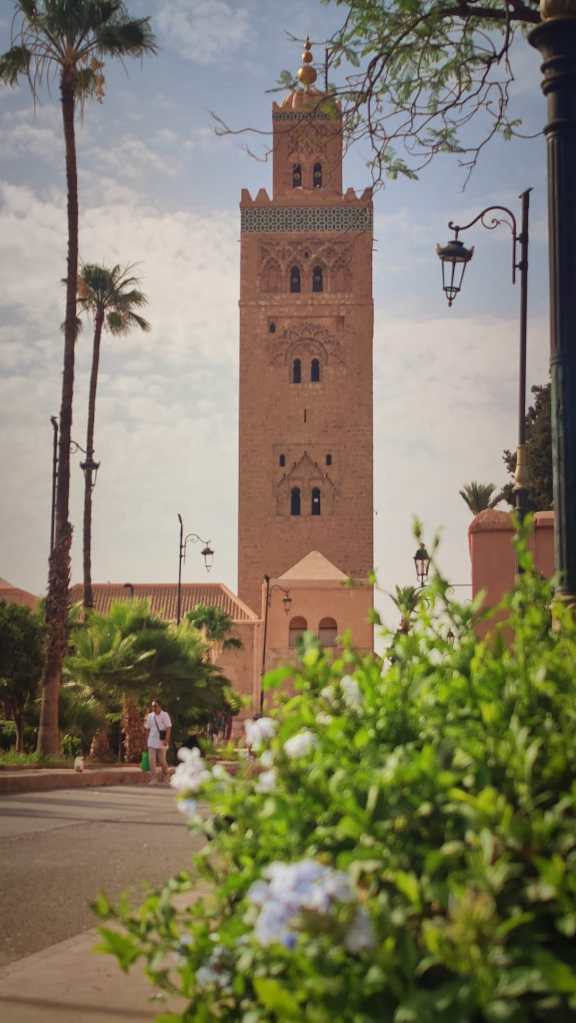
Marrakesh is famed not only for the medina and the souks, but also for its ancient monuments. Morocco is a country steeped in history and Marrakech did not disappoint with its important cultural and traditional buildings. Mr Nomad and I had a stroll to the Koutobia Mosque with its tallest minaret tower at 77 metres which became a landmark for us when we were marching around and trying to get our bearings. It is considered to be an architectural masterpiece. The first Koutobia Mosque was built between 1147 and 1157 and in 1158, the second construction commenced.
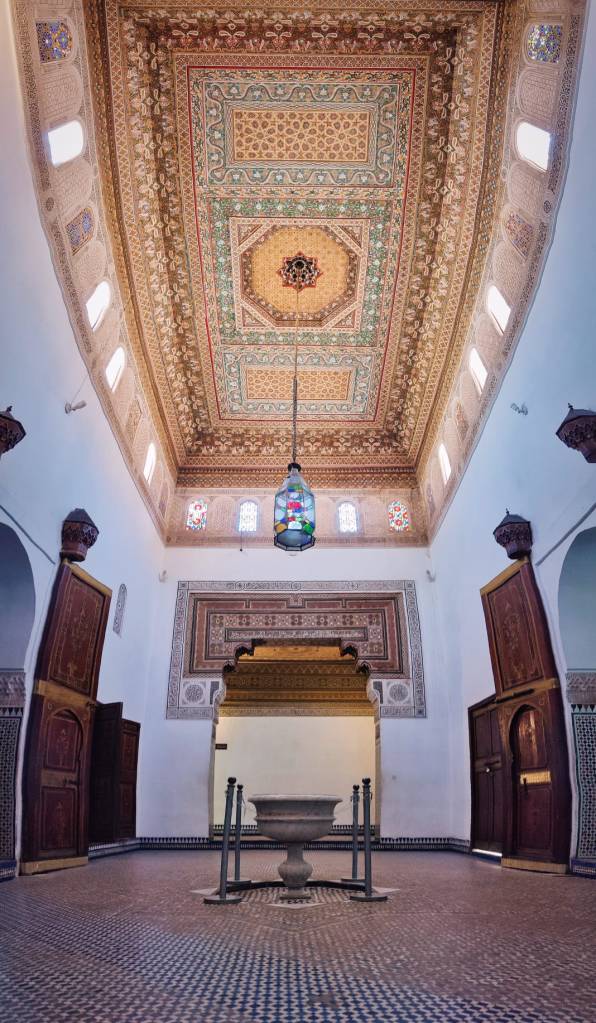
There are a wealth of palaces, riads and museums to visit in Marrakech. Mr Nomad and I visited one of those known as Bahia Palace which is a mid to late 19th century palace. In Arabic, it means “brilliance.” Construction began in 1860’s by Si Musa, who was descended from a family of black slaves but reached the highest office in the country – the Grand Vizier under the Sultan, Muhammed ibn Abd al-Rahman who reigned from 1859 until 1873. The palace was then expanded by Ba Ahmed who effectively became the ruler of Morocco until his death on 1900 from disease. It is incredibly ornate, and glistened beautifully in the sun which bore down upon us. It was a real show of wealth and power which seemed a little out of place in a city as dirty and impoverished as this.
The palace has a labyrinthine layout with various courtyards and riad gardens. The Grand Riad is marble paved and one of the largest spaces within the palace dated around 1896. The palace housed Ba Ahmed’s servants and slaves, as well as his harem with 4 wives, and 24 concubines. After Moroccan independence in 1956, it was used as a royal residence for Kind Mohammed V before being transferred to the Ministry of Culture under King Hassan II when it was turned into a tourist attraction.
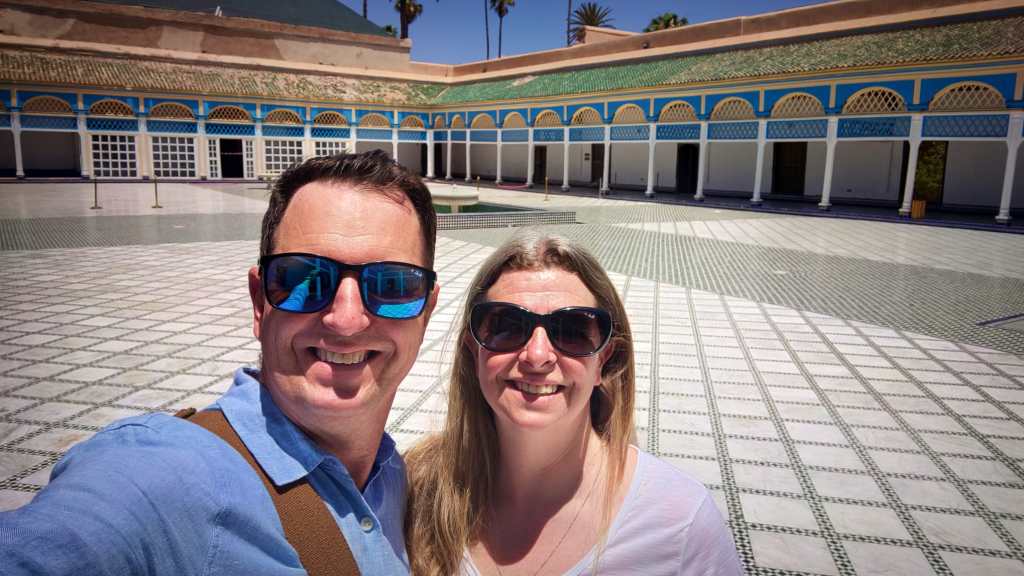
Its famed for the Grand Riad and Small Riad but more so for its ornate and opulent decoration with cedar wood ceilings with colourful floral patterns, sculpted stuccos, mosaics and geometric patterns. It did suffer significant damage during the earthquake in September 2023 but by the time Mr Nomad and I visited, this damage had been repaired and no sign of this was apparent, with the palace retaining its dazzling splendor.
Mr Nomad and I learned about the traditional Hammams, and saw such a set up within the palace itself and although this was a typical social event in the life of a Moroccan, we did not partake. The Hammam is most definitely reminiscent of Roman baths and has been described as not only a space for purification and hygiene but as a rite of passage which punctuates social life. The Hammam is the only public space of purification and would not ordinarily be within an every day Moroccan home, hence we were able to see what the Hammam looked like within Bahia Palace.
We also visited the House of Photography museum which exhibits vintage photography from 1870’s to 1950’s and was a fascinating insight into the real life of a typical Moroccan, including the Berber folk who inhabit the mountains. This museum opened in 2009 to show the diversity of Morocco with a collection including photographs, glass plates, postcards, newspapers, maps and documentaries. This was a snapshot of Moroccan culture and as Mr Nomad is a keen photographer, it was a fascinating find.
For all of our jaunts into the medina, shopping at the souks, pottering around the square and visiting but a few of the many sights to see, we were always pleased to return to the calming tranquility of the Riad, a sanctuary of peace with a serene pool scattered with rose petals; its protective walls around a courtyard belied the carnage outside and the only disturbance being the periodic call to prayer from neighbouring mosques which became strangely comforting.

Marrakesh ambushed me with its vibrancy, its energy, with the colourful chaos and the carnage, but the desert promised a slower pace to our holiday and something in complete contrast to what we had experienced of this wonderful country thus far.
#crazytimes
#sensoryoverload
#onwards
#moreadventurestocome
 Nomadic Family Unit
Leave a comment